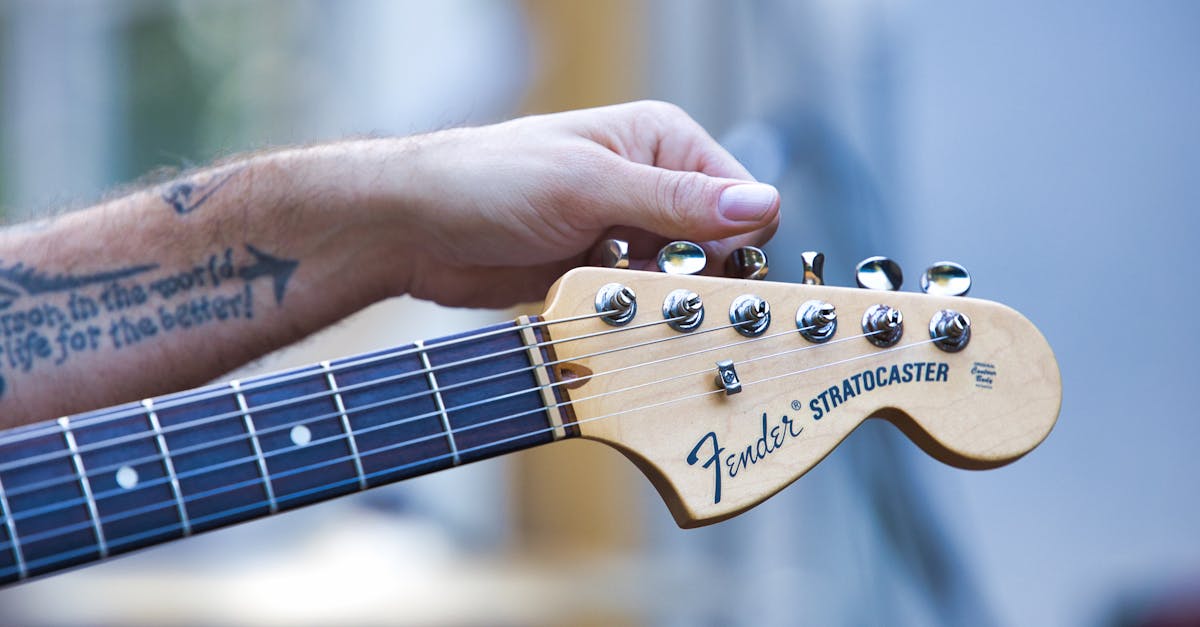
Mastering Electric Guitar Tuning: A Comprehensive Guide
Tuning an electric guitar has become much more straightforward in recent years, thanks to advancements in technology. With a variety of tuners at your disposal, it may seem tempting to rely solely on these devices. However, the ability to tune your electric guitar by ear is an invaluable skill that not only enhances your musical experience but also deepens your connection with the instrument. In this guide, we’ll explore both methods of tuning—with and without a tuner—while enriching your understanding of guitar tunings in general.
Understanding Guitar Tunings
Before diving into the tuning process, it’s essential to grasp what guitar tuning actually entails. At its core, guitar tuning involves assigning specific pitches to each of the guitar’s strings. The goal is to arrange these pitches in a manner that facilitates easier playability for various musical styles.
While numerous tunings exist, the most common one you’ll encounter is standard tuning. This consists of the following string notes from the thickest to the thinnest: E-A-D-G-B-E (or technically, E2-A2-D3-G3-B3-E4). The sixth string is the thickest, descending to the first string, which is the thinnest.
Most alternate tunings follow a similar structure but adjust the pitches to create different musical effects, often referred to as “downtuning.” It’s also worth noting that, apart from the second (B) and third (G) strings—where a major third interval exists—all other strings are tuned in perfect fourths. This characteristic makes playing chords and scales more intuitive.
Most guitar tuning relationships adhere to the A440 standard, indicating that the A4 note vibrates at 440 Hz, serving as a reference point for tuning the rest of the strings.
Pre-Tuning Check
Before you start tuning, a few preliminary checks are essential. Ensure that all hardware on your electric guitar, including tuning machines, nuts, bridges, and saddles, are functioning correctly. Without these components working well, it can be challenging to achieve a stable tune.
Additionally, consider the condition of your strings. Worn-out strings can struggle to hold their pitch. Remember, the guitar is designed so that notes can be replicated at various points along the fretboard. This unique feature will aid tremendously when tuning.
Also, keep in mind that tuning works best with a clean sound, devoid of distortion. If you are using an amplifier, make sure it’s set to a clean channel, or tune your guitar unplugged.
Tuning Your Guitar Without A Tuner
While electronic tuners are certainly convenient, learning to tune your guitar by ear can dramatically improve your musical skills. To start this process, you will need a reference pitch. You can easily access online piano apps or tuning frequency generators. For the most straightforward reference, the open low E string, resonating at 82.41 Hz, is a sensible choice.
When you pluck the string, do so gently yet firmly to ensure it rings out clearly. Avoid repetitive plucking to maintain a consistent pitch. It is advisable to tune upwards towards your target note. If you overshoot the desired pitch, detune slightly and then work your way back up to achieve accuracy.

Once the E string is in tune, you can use the repeating pitches on the fretboard to tune the remaining strings. For instance, play the open E string and the A string together. Make adjustments to the A string until both pitches match.
Continue this process by fretting the A string at the fifth fret and playing the D string. Repeat the same method for the other strings: play the D string at the fifth fret and adjust the G string accordingly.
When tuning the B string, play the G string at the fourth fret, as this string requires a different method. Finally, return to the fifth fret on the B string to tune the high E string.
Although you may find it challenging at first to identify the right pitches, persistence is key. Mastering this technique will significantly aid your understanding of music and your instrument, paving the way for countless sonic explorations.
Tuning Your Guitar With A Tuner
Electronic tuners are indispensable tools for any guitarist. A good tuner can enhance the precision of your tuning process. There are several types available, each offering unique benefits:
-
Traditional Pitch Pipes: These handy devices typically feature six pipes, each corresponding to one string. You blow into a pipe to hear a stable reference note.
-
Chromatic Tuners: Chromatic tuners can recognize all twelve notes in an octave, making them versatile enough for alternate tunings.
-
Electronic Tuners: These tuners, which come in various forms, are often the most popular choice among guitarists. Some have built-in microphones for tuning acoustic guitars without needing to plug them in. Clip-on tuners, which attach to the headstock and sense string vibrations, are especially handy for live settings.
-
Pedal Tuners: These are designed for electric guitars and can mute the signal while you tune, featuring easily readable displays ideal for stage use.
-
Rack-Mounted Tuners: Designed for professional use, these tuners are integrated into more complex setups typical in extensive rigs.
Understanding how your tuner operates is quite simple. Strum a string, and the tuner will detect the frequency, process the sound, and display the result on its screen. If the reading indicates the wrong note, adjust the tension of the string accordingly until you achieve an accurate pitch.
Final Thoughts on Electric Guitar Tuning
As we’ve discussed, learning to tune an electric guitar without a tuner is an essential skill worth mastering. Even if you predominantly rely on electronic tuners in the future, this knowledge will allow you to develop a stronger relationship with your instrument.
Tuning by ear is an art that takes practice, so don’t get discouraged if it takes time to perfect. Use tuners to verify your tuning and track your progress. With diligence and dedication, anyone can master the intricacies of electric guitar tuning.
Stay tuned, practice consistently, and you will find that this journey toward a more profound understanding of your instrument will lead you to greater heights in your musical endeavors.
This post contains affiliate links. If you make a purchase through my links, I may receive a small commission at no additional cost to you. I only recommend products I truly believe in.